The deadliest and biggest tsunamis in history
Wave height is not what kills people. What kills is how far the water gets inland, how many people live in its way and how many minutes of warning they have. That is why the deadliest tsunamis and the biggest ones are two different lists.
The deadliest tsunami on record, in the Indian Ocean in 2004, ran up about 51 m at its worst point. The tallest ever measured, in an Alaskan fjord in 1958, went ten times higher and killed two people in the bay. Side by side, the two rankings explain most of what matters about tsunamis.
What is a tsunami and what causes it?
A tsunami is a series of waves caused by a large, sudden displacement of water. It has nothing to do with tides, whatever the old name "tidal wave" suggests. A wind wave stirs only the top of the sea; a tsunami moves the whole water column down to the seabed.
- Earthquakes cause most tsunamis. At a subduction zone, when the locked fault slips, the seafloor jumps up or drops by metres over an area hundreds of kilometres long. The sea surface follows, and gravity spreads that bulge outwards as waves.
- Landslides into fjords or down underwater slopes make the tallest waves, but they lose energy fast and stay local.
- Volcanoes cause tsunamis by collapsing, by pyroclastic flows entering the sea, or by the blast itself: Krakatau 1883, Hunga Tonga 2022.
- Weather and impacts: sudden pressure jumps in storms cause small "meteotsunamis"; an asteroid hitting the ocean would too (see meteor sizes).
Not every big earthquake makes a big tsunami. The fault must be shallow, under or near the sea, and move the seafloor vertically. A quake that shifts the ground sideways usually makes only a small one. More on magnitudes in the strongest earthquakes ever recorded.
The deadliest tsunamis in history
The ranking uses deaths attributed to the tsunami in NOAA's global tsunami database; old figures are estimates.
Two famous numbers are left out. A 1782 "Taiwan Strait tsunami" with 40,000 deaths survives in old catalogues, but NCEI rates it questionable — no Chinese record mentions it. And Messina 1908, with some 80,000 dead, belongs on an earthquake list: its 12 m tsunami killed an estimated 1,500–2,000 of them.
What the list shares is not wave height. It is crowded coasts, minutes rather than hours between shaking and water, and in most cases no warning at all.
The 2004 Indian Ocean tsunami (Boxing Day tsunami)
At 07:58 local time on 26 December 2004 a magnitude 9.1 earthquake ruptured 1,200–1,300 km of the plate boundary from northern Sumatra to the Andaman Islands. Waves hit Aceh within about 20 minutes and the coast of Somalia seven hours later. Run-up reached 50.9 m in Aceh.
How many people died in the 2004 tsunami? NOAA's database gives 227,899 dead or missing: about 167,500 in Indonesia, 35,300 in Sri Lanka, 16,300 in India, 8,200 in Thailand, 289 in Somalia and more across a dozen other countries. About 1.7 million people were displaced.
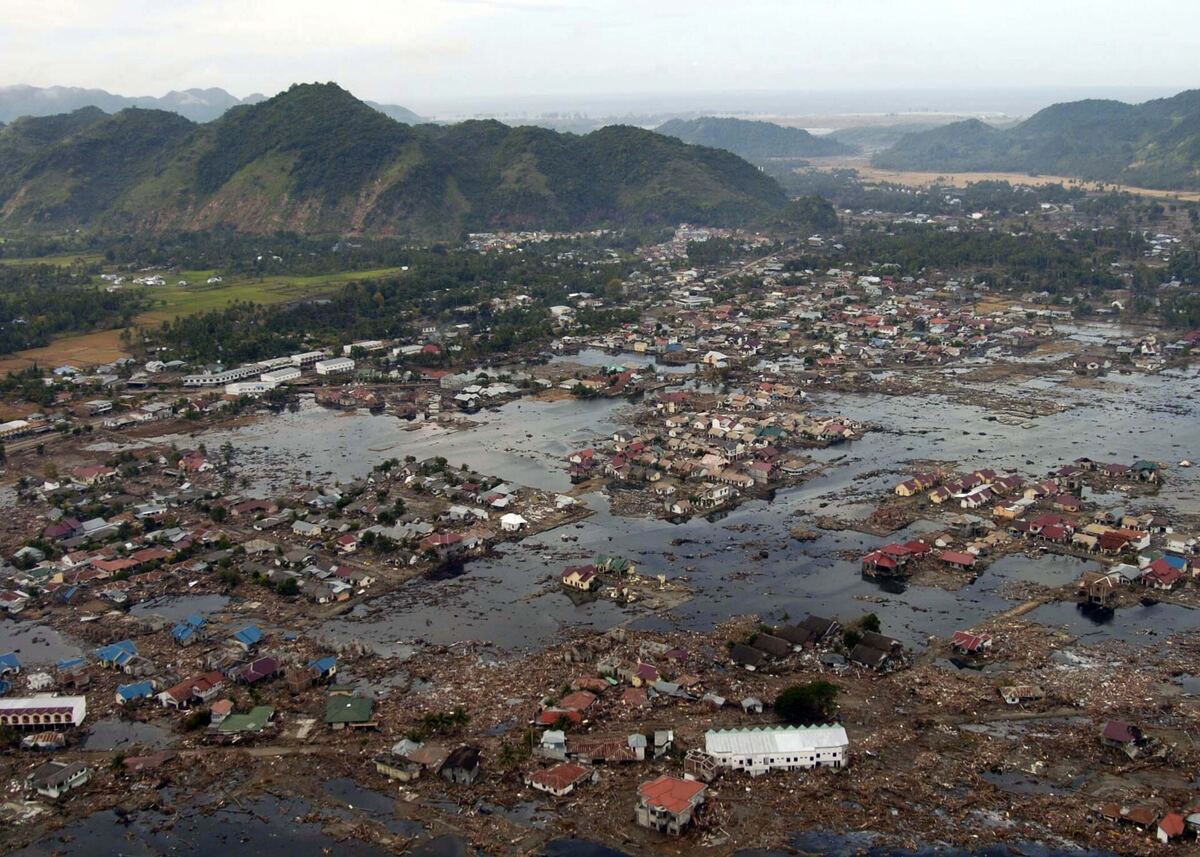
In Thailand the waves were 3–5 m high around Phuket. About 8,200 people died or went missing, many of them foreign tourists; Khao Lak was hit hardest. On Mai Khao beach a ten-year-old British girl, Tilly Smith, recognised the retreating sea from a geography lesson, and the beach was cleared in time.
The island of Simeulue, close to the epicentre, had kept a 1907 tsunami alive in a story called smong: when the ground shakes hard and the sea pulls back, run to the hills. Of about 78,000 islanders, seven died. The Indian Ocean had no warning system in 2004; an interim service began in 2005, and regional centres in Australia, India and Indonesia have issued warnings since 2011.
Drop a 30 m tsunami on Banda Aceh →Japan 2011: the Tōhoku tsunami
On 11 March 2011 a magnitude 9.0–9.1 earthquake broke the plate boundary off northeast Japan. The country had seawalls, drills and one of the best warning systems in the world, and still lost 15,901 people, with 2,519 never found. Of the victims examined in the three worst-hit prefectures, 92% had drowned and nearly two-thirds were 60 or older.
Run-up reached about 40 m on the Iwate coast. On the flat Sendai plain the water pushed more than 5 km inland, and 561 km² of Japan went under water. The tsunami also knocked out cooling at the Fukushima Daiichi nuclear plant.
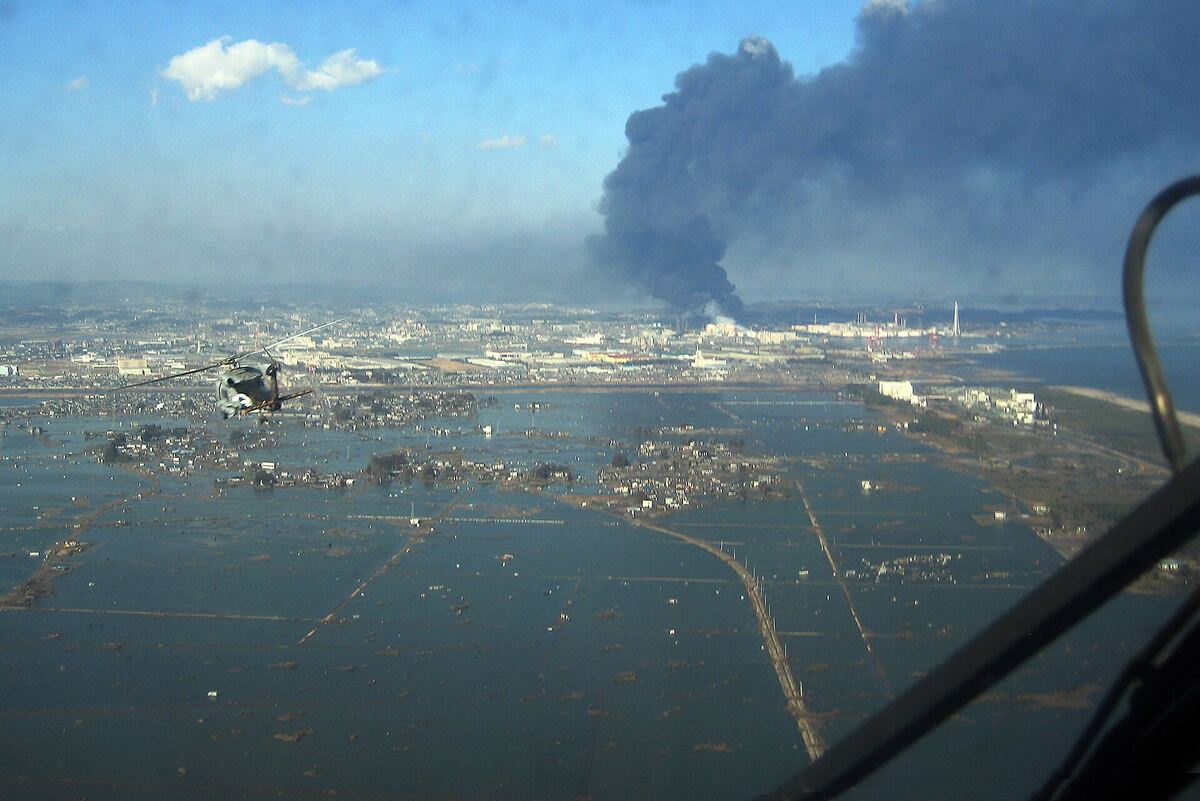
Many seawalls, designed for smaller tsunamis, were simply overtopped. What saved people was leaving at once and going high.
See how far a 15 m wave floods the Sendai plain →Lisbon, Krakatau and other historic tsunamis
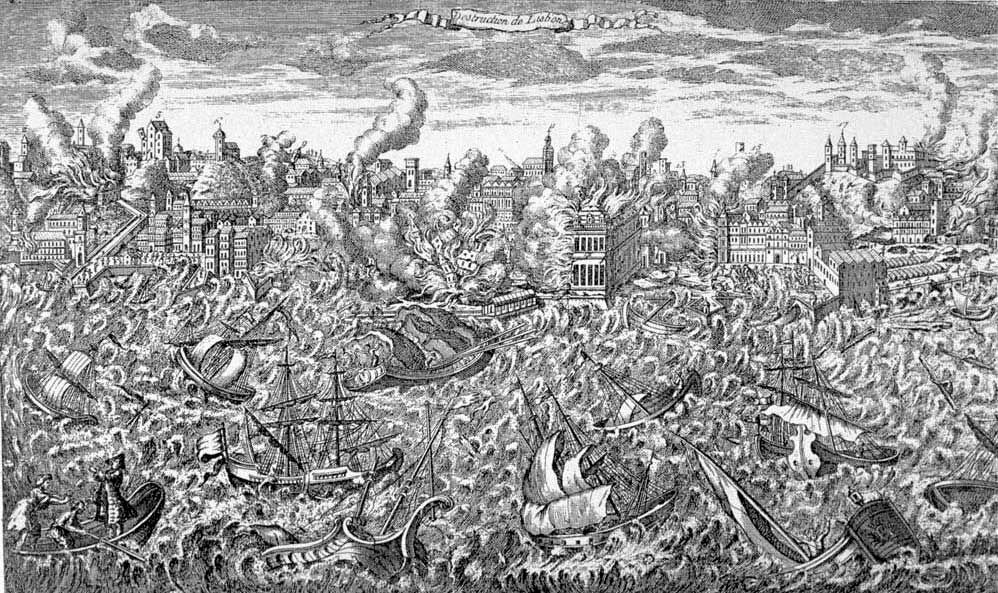
Lisbon, 1 November 1755. The quake, estimated at magnitude 8.5 or more, struck on All Saints' Day while churches were full. Survivors ran to the open waterfront, which is where the tsunami found them; on the Algarve coast waves locally topped 30 m. Estimates of the total toll range from tens of thousands to about 100,000 across Portugal, Spain and Morocco.
Send a 15 m wave into Lisbon →Krakatau, 27 August 1883. The eruption sent waves 30–40 m high over the Sunda Strait, destroying more than 250 villages. NOAA attributes 34,417 of about 36,400 deaths to the water, not the eruption (see the biggest volcanic eruptions).
Sanriku, Japan, 15 June 1896. The shaking was weak and villages were celebrating a holiday; within half an hour waves up to 38 m killed about 27,000. It was a "tsunami earthquake" — a slow rupture that shakes gently but lifts a lot of seafloor — which is why the advice is to leave the coast after any long quake, even a mild one.
Kamchatka and the Kurils, 4–5 November 1952. A magnitude 9.0 earthquake sent waves onto 700 km of Soviet coast within 30–40 minutes. In Severo-Kurilsk, people who escaped the first wave went back down and were caught by the stronger second one. The official toll was 2,336; later estimates reach 4,000–14,000, and the disaster stayed secret until the 1990s.
Chile, 22 May 1960. The strongest earthquake ever recorded, M9.5, killed some 1,000–2,000 people in Chile, mostly by tsunami. The waves then crossed the Pacific, killing 61 people in Hilo, Hawaii, 15 hours later, and about 140 in Japan.
The biggest tsunamis ever recorded
"Biggest" usually means run-up: the height above normal sea level of the highest point the water reaches on land. By that measure the ranking changes completely, and most of the top entries killed nobody.
All top seven were landslides into confined water — a fjord, a lake, a reservoir. These are the mega-tsunamis (megatsunamis): not a formal term, but usually meaning run-up of 100 m or more. The deadliest of them, Vajont, killed about 2,000 people when the wave overtopped a 262 m dam and destroyed the town of Longarone below.
Earthquake tsunamis rarely run up more than 40–50 m, but they move vastly more water across entire oceans. That is why the three shortest bars here sit near the top of the deadliest list.
Lituya Bay 1958: the tallest tsunami ever recorded
On the night of 9 July 1958 a magnitude 7.8 earthquake shook about 30 million m³ of rock from a cliff at the head of Lituya Bay, a narrow fjord in southeast Alaska. The rock fell into Gilbert Inlet, and the displaced water surged 524 m (1,720 ft) up the ridge opposite, stripping the forest to bare rock. It remains the classic example of a megatsunami.
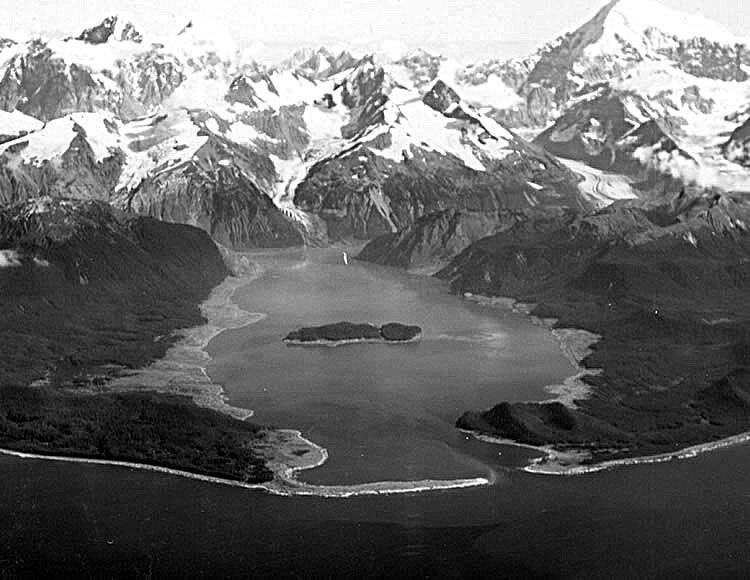
Three fishing boats were anchored in the bay. The Sunmore sank with Orville and Mickey Wagner. The Badger was swept over the spit and sank, but its owners survived in a skiff; Howard Ulrich and his seven-year-old son rode out the wave in the Edrie. Three more people died in Yakutat Bay. The wave crossing the bay itself was far lower — tens of metres.
Lituya Bay had done this before, with run-ups of 120 m in 1853–54 and 149 m in 1936. And on 10 August 2025 it happened again less than 300 km away: a landslide of at least 64 million m³, loosened by a retreating glacier, fell into Tracy Arm, a fjord popular with cruise ships south of Juneau. Water climbed 481 m up the opposite wall. Nobody was hurt, largely because no ships were there at 5:26 a.m. Retreating glaciers are exposing more such slopes.
How fast, how tall and how far a tsunami goes
How fast does a tsunami travel?
Speed depends almost only on depth: v = √(g·d). Over 4,000 m of ocean a tsunami moves at about 713 km/h, as fast as a jet airliner. Over the 200 m continental shelf it slows to about 160 km/h, and in 10 m of water to about 36 km/h — still faster than anyone can run.
How tall can a tsunami get?
In the open ocean a tsunami is usually under a metre high and hundreds of kilometres long, so ships barely notice it. At the coast, the US National Weather Service notes, most are under 3 m (10 ft), but extreme ones exceed 30 m (100 ft).
How far inland can a tsunami go, and how far can it travel?
Inland reach depends on the ground. Where hills rise near the shore, even a huge wave stops within a few hundred metres; on a flat plain a large tsunami floods several kilometres inland, as at Sendai, and runs further up rivers. Across open ocean a large tsunami can cross an entire basin: the 2004 waves killed people in Somalia, some 5,000 km from the epicentre, and the 1960 Chilean tsunami killed people in Japan, about 17,000 km away.
How long does a tsunami last?
Waves arrive 5 minutes to 2 hours apart, and flooding, draining and re-flooding go on for hours; the danger can last a day or more. The first wave is often not the largest. After the 1868 Arica earthquake the sea kept surging around the Pacific for two to three days.
When was the last tsunami?
Small tsunamis happen every few weeks: NOAA's database lists more than twenty in 2025 alone, most only centimetres high. The notable ones of recent years, as of September 2026:
- Mindanao, Philippines, June 2026. An M7.8 earthquake produced run-up of about 2.5 m.
- Tracy Arm, Alaska, 10 August 2025. The 481 m landslide mega-tsunami described above.
- Kamchatka, 29–30 July 2025. An M8.8 earthquake, the strongest anywhere since Tōhoku in 2011, brought 3–4 m waves to parts of the Kamchatka coast and flooded the port of Severo-Kurilsk; surveys later found run-up of up to 17 m. Japan told about 1.9 million people to evacuate, and waves reached 1.74 m on Maui. Nobody was killed by the water — Severo-Kurilsk had been rebuilt on higher ground after 1952.
- Noto Peninsula, Japan, 1 January 2024. An M7.5 quake caused run-up of up to about 11 m.
- Hunga Tonga–Hunga Haʻapai, 15 January 2022. The eruption sent waves across the Pacific, destroying villages in Tonga, where they reached about 15 m, and drowning two people in Peru.
This page is not a live feed — for current alerts use the warning centres below. To see what visitors have simulated over the last 30 days, open recent simulations.
How to survive a tsunami
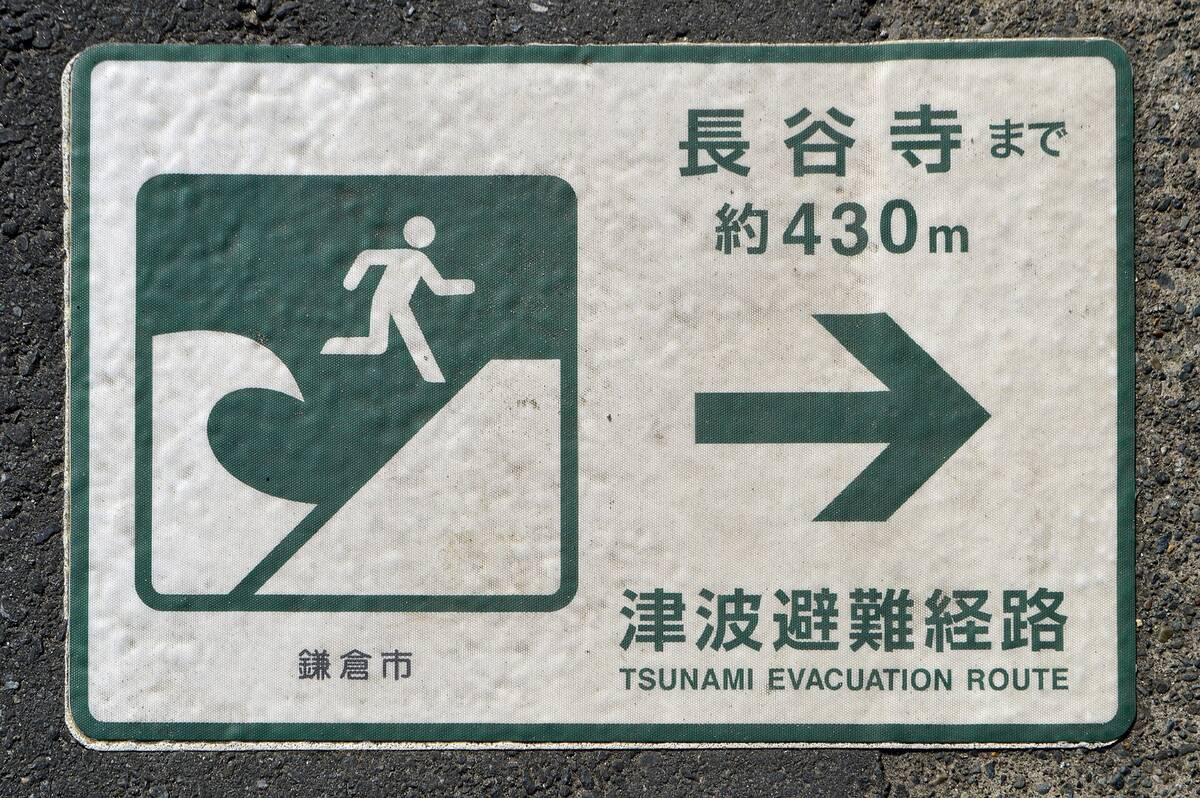
- Go high or inland, on foot. Follow evacuation signs out of the hazard zone. If you cannot get out in time, climb to the upper floors of a tall reinforced-concrete building.
- Don't go to look. A drained seabed is the wave pulling back.
- Don't return after the first wave. Stay away until officials say it is safe, which can take many hours. In Severo-Kurilsk the second wave killed people who had gone back.
- On a boat, follow harbour instructions; if already well offshore in deep water, stay there.
- Prepare in advance. Find out whether your home, hotel or school is in a tsunami zone, where the nearest high ground is and how long the walk takes. Agree a family meeting point.
Official warnings come from the US Tsunami Warning Centers in Hawaii and Alaska, the Japan Meteorological Agency and, for the Indian Ocean, regional centres in Australia, India and Indonesia; locally, follow your national emergency service.
Check how far a 10 m wave reaches into Hilo, Hawaii →FAQ
How many people died in the 2004 tsunami?
NOAA's global tsunami database lists 227,899 people dead or missing after the 26 December 2004 Indian Ocean tsunami, about 167,500 of them in Indonesia. It is the deadliest tsunami in recorded history.
What is the biggest tsunami ever recorded?
The tallest was at Lituya Bay, Alaska, on 9 July 1958, when a rockslide pushed water 524 m up a mountainside. The second tallest was the 481 m landslide tsunami in Tracy Arm, Alaska, in August 2025.
How fast does a tsunami travel?
About 713 km/h (440 mph) over 4,000 m of ocean, about 160 km/h over the continental shelf and about 36 km/h in 10 m of water. Even near shore it is faster than a person can run.
How tall can a tsunami get?
In the open ocean usually less than a metre. At the coast most are under 3 m, the largest earthquake tsunamis run up 40–50 m, and landslide tsunamis in fjords have reached 524 m.
How far inland can a tsunami go?
On steep coasts a few hundred metres; on flat plains several kilometres, and further along rivers. In 2011 it reached more than 5 km inland on the Sendai plain.
How long does a tsunami last?
Waves keep arriving 5 minutes to 2 hours apart for many hours, and the first is often not the biggest. Stay on high ground until officials say it is safe.
Sources
- NOAA NCEI — Global Historical Tsunami Database (event and run-up data)
- USGS — Tsunami generation from the 2004 M9.1 Sumatra-Andaman earthquake
- UNESCO-IOC — Indian Ocean Tsunami Warning and Mitigation System
- Procedia Environmental Sciences (2014) — Smong, early warning system from Simeulue Island, Aceh
- National Police Agency of Japan — Damage situation of the 2011 Tōhoku earthquake
- Mori et al. (2011), Geophysical Research Letters — Survey of 2011 Tohoku earthquake tsunami inundation and run-up
- UNESCO-IOC Tsunami Programme — 22 May 1960, Chile
- USGS — Miller (1960), Giant waves in Lituya Bay, Alaska, Professional Paper 354-C
- USGS — 2025 Tracy Arm landslide-generated tsunami
- Science (2026) — A 481-meter-high landslide-tsunami in a cruise ship–frequented Alaska fjord
- Svennevig et al. (2024), Science — A rockslide-generated tsunami in a Greenland fjord rang Earth for 9 days
- UNESCO-IOC — Global tsunami response to the 29 July 2025 M8.8 Kamchatka earthquake
- NOAA National Weather Service — Tsunami safety