What an asteroid impact does, size by size
Almost everything that falls from space never reaches the ground. What decides the outcome is size and what the body is made of, and the bigger the rock, the longer the wait for the next one.
Impacts come in a ladder. At the bottom, a car-sized rock lights up the sky about once a year and nobody on the ground notices. At the top, a body ten kilometres across ends a geological era. In between sit the cases that happen on human timescales: a city's windows blown in, a forest knocked flat, a crater you can walk around. Each rung is much rarer than the one below, and what the body is made of matters almost as much as its size.
HazardSim is an asteroid simulator: pick a diameter, choose stone, iron or ice, and drop it anywhere on a real map. The links below open it at the right size and place.
Meteor, meteorite, asteroid: three words, one rock
An asteroid is a rocky or metallic body orbiting the Sun. Below about a metre, the International Astronomical Union calls it a meteoroid; the line is a convention, not physics. A meteor is not an object but the streak of light as a body tears through the atmosphere; a very bright one is a fireball or bolide. A meteorite is whatever survives and lands. Comets are the icy cousins and fall apart even more easily than stone. So Meteor Crater was dug by an asteroid, the Chelyabinsk fireball was a meteor, and the stones later picked out of the snow were meteorites.
Up to 25 m: a fireball and broken glass
According to NASA, space rocks smaller than about 25 m will most likely break up in the atmosphere and cause little or no damage. A car-sized one arrives about once a year. A few are now caught before they hit: the first was 2008 TC3, a rock of about 4 m spotted the day before it burst over Sudan in 2008. The eleventh, 2024 XA1, about 70 cm across, lit up the sky over Yakutia on 3 December 2024, ten hours after discovery.
The top of this rung is Chelyabinsk. At 09:20 local time on 15 February 2013 a stony asteroid about 19–20 m across and roughly 13,000 tonnes entered the atmosphere over the southern Urals at 19 km/s, on a shallow track. Nobody had seen it coming: it approached from the direction of the Sun. It broke apart and was brightest about 30 km up, releasing roughly 440–500 kilotons of TNT equivalent; published estimates differ by up to a factor of two.
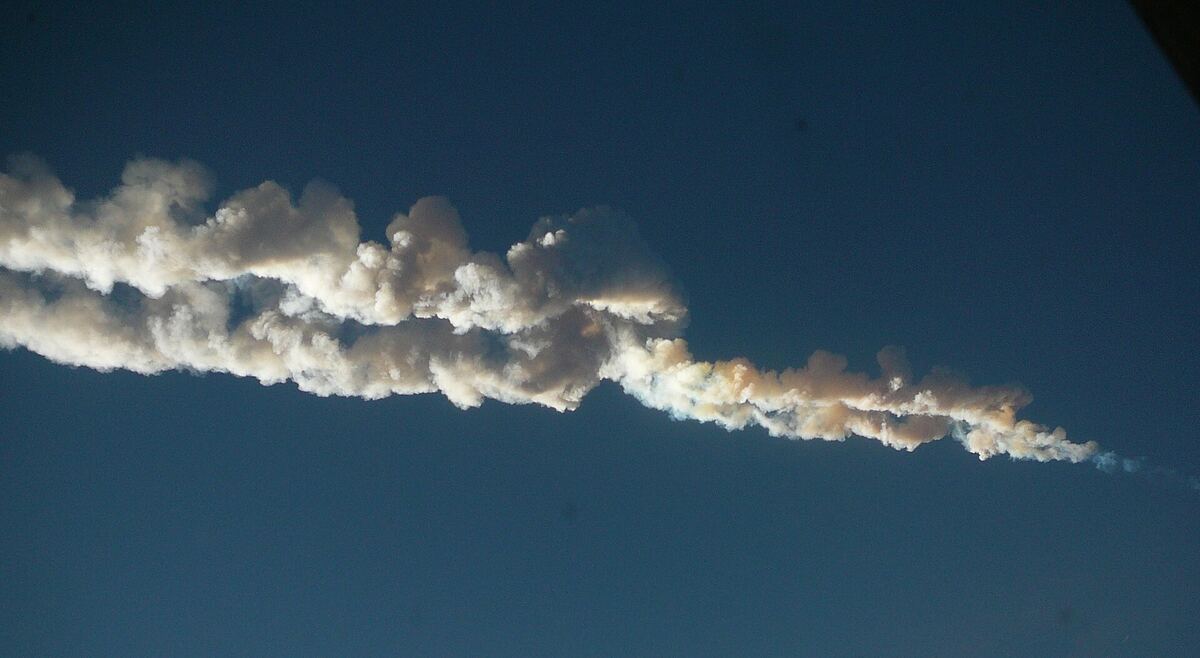
The rock itself hit nobody; the shock wave did the damage. In Chelyabinsk alone some 3,600 apartment buildings, about 44% of them, had windows shattered. A zinc factory roof collapsed. About 1,600 people were hurt, almost all by flying glass. The field survey found 4–6 tonnes of meteorites, including a piece of more than half a tonne pulled from the bed of Lake Chebarkul. There was no crater, and there was never going to be one.
Replay a 20 m stone over Chelyabinsk →
40–80 m of stone: Tunguska, 1908
At about 7:15 in the morning on 30 June 1908, something exploded over the taiga near the Podkamennaya Tunguska river in central Siberia. The blast flattened roughly 2,150 km² of forest, an estimated 80 million trees, in a butterfly-shaped pattern. Near the centre, trees were left standing but stripped of their branches, because the blast came from directly above. The region was so remote that there were very few human casualties, and the first scientific expedition, led by Leonid Kulik, only reached the site in 1927. He expected a giant iron meteorite and found no crater at all.
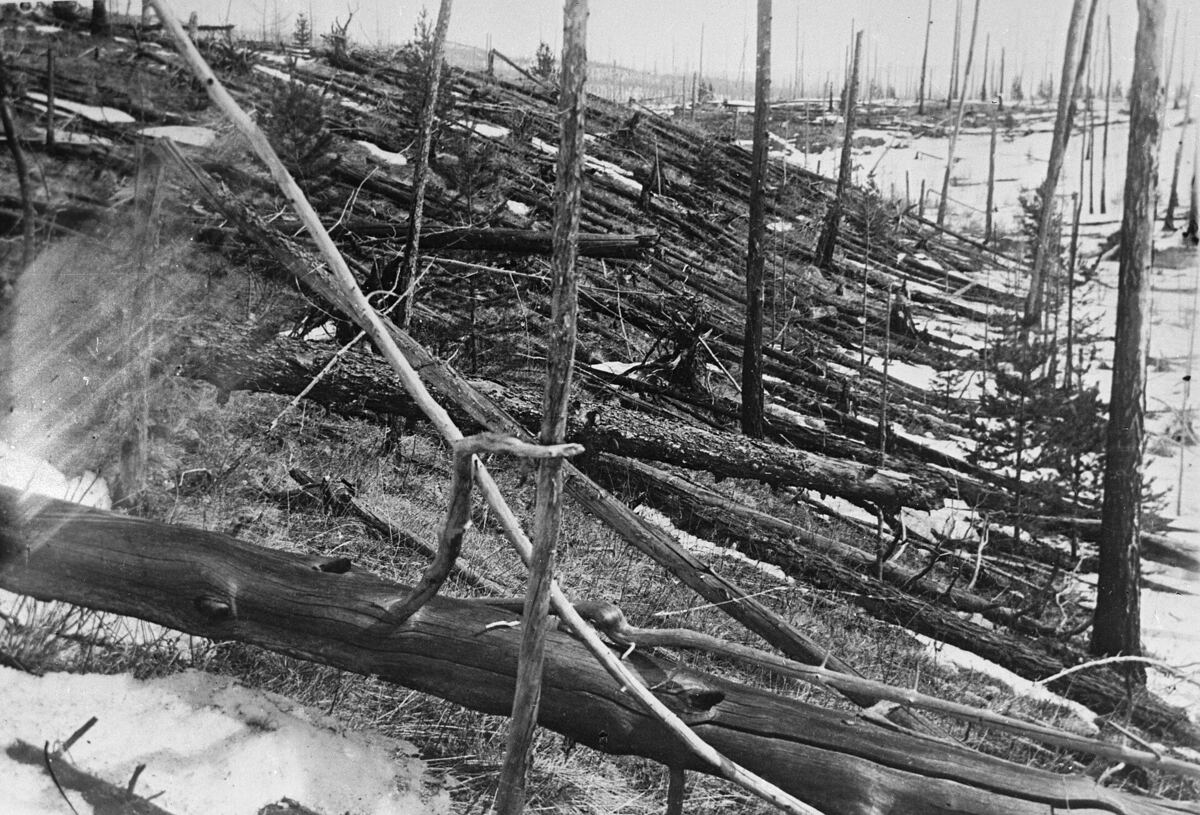
A century of work has narrowed the uncertainty without closing it. The body was most likely a stony asteroid of 40–80 m that detonated roughly 5–15 km up. Energy estimates run from 3–5 megatons (Sandia supercomputer models) to 10–30 megatons (NASA-sponsored studies of 2019); the US National Academies quote 3–20. Either way it is the largest impact event in recorded history.
The epicentre lies at almost the latitude of Saint Petersburg, hence the popular claim that a few hours' delay would have put the blast over the imperial capital. That is a thought experiment, not a calculation. The real point is simpler: a Tunguska over any metropolis would be a regional catastrophe with no crater to show for it.
40–50 m of iron: Meteor Crater, Arizona
About 50,000 years ago, an iron-nickel asteroid hit the plateau east of Flagstaff. It left the best-preserved impact crater on Earth: a bowl about 1.2 km across and 180 m deep, its rim 30–60 m above the plain. A widely cited 2005 model has a body of about 40 m and 300,000 tonnes that partly broke up in the air and hit at around 12 km/s; other models go up to about 50 m. Recent energy estimates range from about 1 to 10 megatons. Its fragments are known as the Canyon Diablo meteorite.
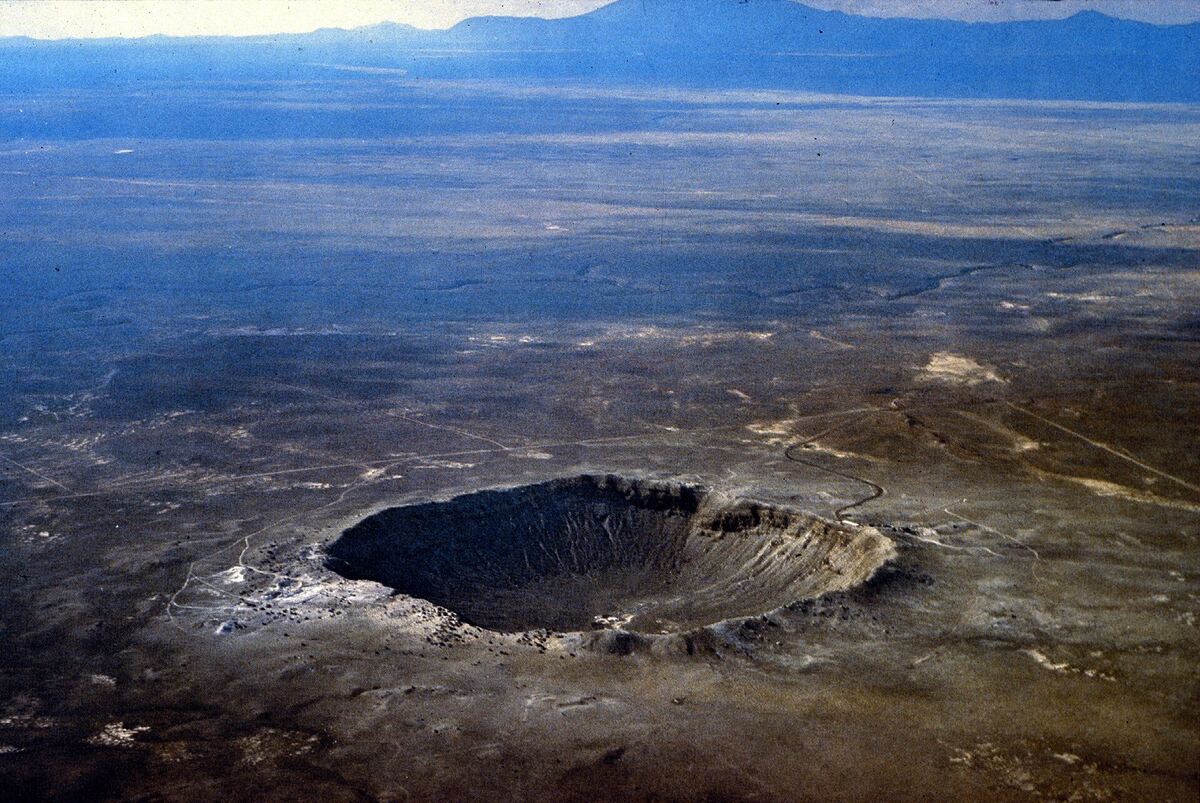
Why does a 40 m iron make a kilometre-wide hole when a stone of similar size over Tunguska made none? Iron is more than twice as dense as stone and far stronger. The Canyon Diablo body was about twice the diameter of the Chelyabinsk rock, yet it carried roughly 28 times the mass. It punched through the atmosphere largely intact, where a stone is crushed and explodes. That is why most of Earth's small craters were made by irons; even the 1947 Sikhote-Alin iron shower in the Russian Far East, which broke up in the air, dug craters up to about 27 m wide.
Drop a 50 m iron body back on Meteor Crater →
About 150 m: what a "city killer" means
"City killer" is an informal label, not a scientific class: asteroids big enough to wipe out a metropolitan area but far too small to threaten civilisation, roughly from Tunguska size to a couple of hundred metres. Around 140 m is where NASA draws its survey line. An object that size hits with more than 60 megatons, more than the largest nuclear bomb ever tested, and it reaches the ground whatever it is made of. Such impacts average about once every 20,000 years.
In the simulator a 150 m stone digs a crater about 3 km wide, destroys everything within roughly 12 km, and breaks windows tens of kilometres out: one city gone, the rest of the planet reading about it. In the ocean it would add a tsunami; see the deadliest tsunamis.
Drop a 150 m stone on Chicago →
The term went mainstream with 2024 YR4. The ATLAS survey in Chile found it on 27 December 2024, and the James Webb Space Telescope later sized it at about 60 m, the height of a 15-storey building. As astronomers added observations, its chance of hitting Earth on 22 December 2032 climbed, peaking at just over 3% on 18 February 2025. That was the highest ever recorded for an object that size, and it rated 3 on the Torino scale. Within a week the probability had fallen to 0.004%.
That rise-then-fall is normal: while Earth sits inside the shrinking cloud of possible orbits, the odds grow, until the cloud slides off. YR4 then kept a 4.3% chance of hitting the Moon, until Webb observations in February 2026 ruled that out too. It will pass about 21,000 km from the lunar surface.
340 m: Apophis and 13 April 2029
Apophis was discovered at Kitt Peak, Arizona, on 19 June 2004. In December that year its odds of hitting Earth in 2029 briefly reached 2.7%, and it became the only object ever rated 4 on the Torino scale. Better orbits ruled out 2029, then 2036, and in 2021 radar removed the last worry, 2068: NASA finds no risk from Apophis for at least a hundred years.
It is about 340 m across by NASA's estimate (ESA gives about 375 m), elongated and possibly two-lobed like a peanut. On the evening of 13 April 2029 (UTC) it will pass about 32,000 km above the surface, inside the ring of geostationary satellites. It will be visible to the naked eye from Europe, Africa and parts of Asia. An asteroid this large passes this close only every few thousand years.
Two spacecraft will be waiting. ESA's Ramses, run jointly with Japan's JAXA and approved in November 2025, launches in April 2028 and arrives in February 2029 to watch how Earth's gravity reshapes the asteroid. NASA's OSIRIS-APEX, the former OSIRIS-REx, arrives shortly after the flyby for an 18-month survey. Had Apophis been on a collision course, it would have delivered about 1,600 megatons by NASA's standard assumptions: a regional catastrophe on the scale of a country, not an extinction.
See an Apophis-sized impact on New York →
1 km and up: damage stops being local
NASA's rule of thumb is that anything larger than one to two kilometres could have worldwide effects. Of an estimated 930 or so near-Earth asteroids of 1 km and larger, more than 90% have been found, and none is on a collision course. Such impacts average roughly once every half a million years. The simulator stops at 3,000 m for a reason: past a kilometre, the local blast radius is no longer the story.
10 km: Chicxulub, the asteroid that killed the dinosaurs
How big was it? About 10 km across by the usual estimate, with some models going to 12 km or more. Ruthenium isotopes in the fallout layer, analysed in 2024, show it was a carbonaceous asteroid, a dark, carbon-rich type. It came in steeply, at around 60° from the northeast, 66 million years ago. The energy is uncertain by about an order of magnitude but is commonly put at around 100 million megatons.
Where did it land? On the northern edge of Mexico's Yucatán Peninsula, then a shallow sea shelf. The crater, about 180–200 km wide, is centred near the coastal town of Chicxulub Puerto, with roughly half of it under the Gulf of Mexico. It is buried under hundreds of metres of younger rock, so you cannot see it. It was confirmed as the impact site in 1991, and in 2016 a drilling expedition cored its peak ring from beneath the seabed.
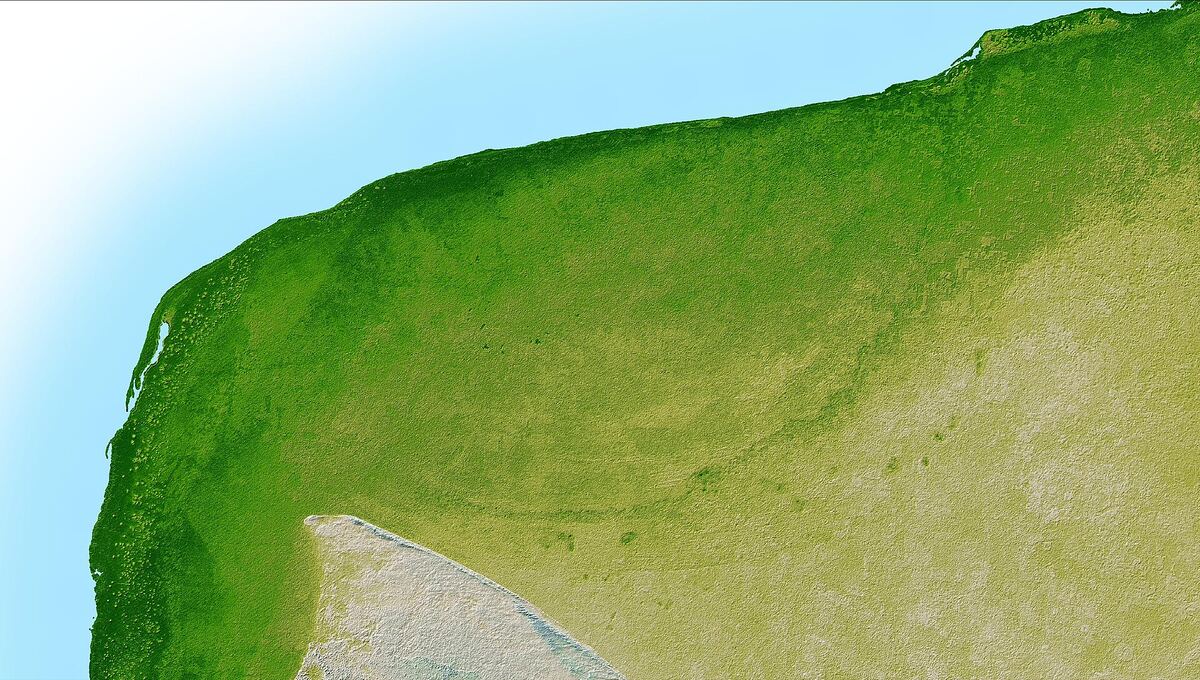
At this scale the crater is the least of it. Molten ejecta rained back around the planet, wildfires and tsunamis followed, and dust, soot and sulfur darkened the sky for years. About three quarters of all species disappeared, including every dinosaur that was not a bird. Impacts this big average about once every 100 million years.
How often each size hits Earth
The figures below are long-run averages from NASA's population models and the US National Academies, not a schedule. Chelyabinsk and Tunguska came 105 years apart; that says nothing about when the next one is due.
Energy goes with the cube of the diameter: double the size, eight times the energy. Chelyabinsk was about 30 Hiroshimas; Chicxulub was millions of the largest bomb ever built.
| Size | What happens | Example | How often |
|---|---|---|---|
| ~4 m | Bright fireball, scattered meteorites | 2008 TC3, Sudan | ~yearly |
| ~20 m stone | High airburst; windows broken across a region | Chelyabinsk, 2013 | 50–100 yr |
| 40–80 m stone | Low airburst; forest flattened over ~2,000 km², no crater | Tunguska, 1908 | 1,000+ yr |
| 40–50 m iron | Reaches the ground; crater about 1 km wide | Meteor Crater, ~50,000 yr ago | rarer: few bodies are iron |
| ~140 m | Ground impact; a city and its surroundings destroyed | none in recorded history | ~20,000 yr |
| ~1 km | Continental damage, global climate effects | none in recorded history | ~500,000 yr |
| ~10 km | Mass extinction | Chicxulub, 66 Myr ago | ~100 Myr |
Is an asteroid going to hit Earth?
Not any asteroid we know of, not this century. NASA's Sentry system at JPL continuously checks every known near-Earth object for possible impacts over the next 100 years, and ESA's Near-Earth Object Coordination Centre keeps an independent list. In September 2026 Sentry listed about 2,200 objects with a non-zero chance of impact, none rated above 0 on the Torino scale: almost all are small rocks with poorly known orbits that drop off as observations come in.
The Torino scale runs from 0 (no hazard) to 10 (certain collision with global consequences). Level 1 means routine, and levels 2–4 mean astronomers should pay attention. Nothing has ever gone above 4. Among large known asteroids, the most closely watched is Bennu, the 490 m rock NASA sampled: its chance of an impact between 2178 and 2290 is about 1 in 1,750.
The honest caveat is the asteroids nobody has found yet. More than 42,000 near-Earth asteroids are known, but of the estimated 25,000 larger than 140 m, fewer than half have been discovered. Most Chelyabinsk-sized rocks will only ever be seen as they arrive, if at all. NASA's NEO Surveyor infrared telescope, due to launch no earlier than September 2027, and the Vera C. Rubin Observatory in Chile are meant to close that gap.
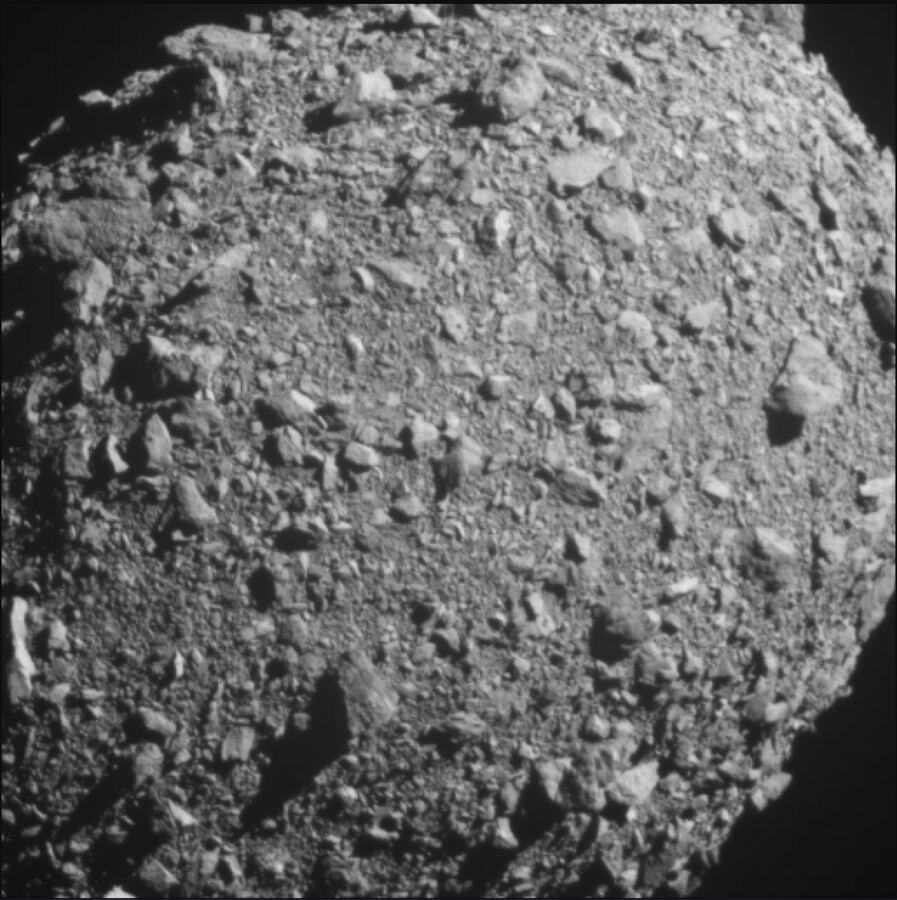
If something is found, there is now proof that we can push it. On 26 September 2022 NASA's DART spacecraft flew into Dimorphos, a moonlet about 160–170 m across that circles the asteroid Didymos. Its roughly 12-hour orbit shrank by 33 minutes, several times more than the spacecraft's momentum alone could explain, because the ejected rubble added its own push. A 2026 analysis found that even the pair's path around the Sun had shifted slightly. ESA's Hera probe arrives in late 2026 to inspect the result. But a nudge like that needs years of warning, so finding the asteroids comes first.
To see where other visitors have been dropping rocks, look at what people simulated in the last 30 days.
FAQ
Is an asteroid going to hit Earth?
No known asteroid is on course to hit Earth in the next 100 years. NASA's Sentry system and ESA's coordination centre track every known near-Earth object, and none currently rates above zero on the Torino hazard scale. Small undiscovered rocks still arrive, a Chelyabinsk-sized one every 50–100 years on average.
What is a city-killer asteroid?
An informal name for an asteroid big enough to destroy a city but not to cause global effects, roughly 50 m to a couple of hundred metres across. A 140 m body would hit with more than 60 megatons; that happens about once every 20,000 years. The term took off with 2024 YR4, a 60 m asteroid whose 2032 impact odds briefly topped 3% in 2025 before being ruled out.
Will Apophis hit Earth in 2029?
No. On 13 April 2029 the 340 m asteroid Apophis will pass about 32,000 km above Earth's surface, closer than geostationary satellites, and will be visible to the naked eye from Europe, Africa and parts of Asia. Radar observations in 2021 ruled out any impact for at least the next hundred years.
How big was the asteroid that killed the dinosaurs, and where did it land?
About 10 km across, possibly somewhat larger. It struck 66 million years ago on the northern edge of Mexico's Yucatán Peninsula, near today's Chicxulub Puerto, leaving a buried crater about 180–200 km wide, half of it under the Gulf of Mexico.
How big is Meteor Crater in Arizona?
Meteor Crater, also called Barringer Meteorite Crater, is about 1.2 km across and 180 m deep, with a rim 30–60 m above the surrounding plain. It formed about 50,000 years ago when an iron-nickel asteroid roughly 40–50 m across hit the ground. A stony body of the same size would have exploded in the air instead.
What is the difference between a meteor, a meteorite and an asteroid?
An asteroid is a rocky or metal body orbiting the Sun; pieces smaller than about a metre are called meteoroids. A meteor is the streak of light made when such a body burns through the atmosphere. A meteorite is the fragment that survives and lands on the ground.
Sources
- US National Academies — Origins, Worlds, and Life (2022), ch. 18: Planetary Defense
- NASA — Report of the Near-Earth Object Science Definition Team (2017)
- NASA — Asteroid Fast Facts
- IAU Commission F1 — Definitions of terms in meteor astronomy (2017)
- ESA NEO Coordination Centre — 2024 XA1
- Popova et al., Science (2013) — Chelyabinsk airburst, damage assessment, meteorite recovery
- NASA — Five years after the Chelyabinsk meteor
- NASA — 115 years ago: the Tunguska asteroid impact event
- NASA — Tunguska revisited (2019)
- Sandia National Laboratories — New explanation of the Tunguska disaster (2007)
- Lunar and Planetary Institute — Kring, Guidebook to the Geology of Barringer Meteorite Crater
- Melosh & Collins, Nature (2005) — Meteor Crater formed by low-velocity impact
- NASA — Asteroid 2024 YR4
- NASA — 2024 YR4 poses no significant threat to Earth (February 2025)
- NASA — New observations eliminate chance of 2032 lunar impact (March 2026)
- NASA — Apophis facts
- NASA JPL — Earth is safe from asteroid Apophis for 100-plus years (2021)
- ESA — Ramses: ESA's mission to asteroid Apophis
- Fischer-Gödde et al., Science (2024) — Ruthenium isotopes show the Chicxulub impactor was a carbonaceous-type asteroid
- Collins et al., Nature Communications (2020) — A steeply-inclined trajectory for the Chicxulub impact
- IODP — Expedition 364 summary: drilling the Chicxulub peak ring
- Schulte et al., Science (2010) — The Chicxulub asteroid impact and mass extinction at the Cretaceous–Paleogene boundary
- NASA JPL CNEOS — Sentry: Earth impact monitoring
- NASA JPL CNEOS — The Torino Impact Hazard Scale
- NASA — NEO Surveyor
- Thomas et al., Nature (2023) — Orbital period change of Dimorphos due to the DART kinetic impact
- NASA JPL — DART changed the orbit of asteroid Didymos around the Sun (2026)