The biggest volcanic eruptions in history — and the VEI scale
The Volcanic Explosivity Index is a volume scale: every step above VEI 2 means roughly ten times more rock and ash thrown out. Here is what each step does — to the valley next door and to the climate of the whole planet.
Earthquakes have magnitude; eruptions have the Volcanic Explosivity Index, proposed in 1982 by Chris Newhall of the USGS and Stephen Self. It asks how much material came out and how high it went — and the answers span a factor of a hundred million. That is why "the biggest eruption in history" has several correct answers, separated by factors of ten.
What the Volcanic Explosivity Index measures
The VEI runs from 0 to 8 and rests mainly on the bulk volume of tephra — ash, pumice and rock fragments — plus the height of the eruption column. VEI 0 is under 10,000 m³, VEI 1 starts at 10,000 m³ and VEI 2 at a million. From there each step is ten times the last: VEI 5 begins at 1 km³, VEI 6 at 10, VEI 7 at 100 and VEI 8 at 1,000 km³. A VEI 7 is not "a bit worse" than a VEI 5; it is a hundred times more material.
What each step does
VEI 0–2 are the lava fountains of Hawaii and the bursts of Stromboli: dangerous within a few kilometres, irrelevant beyond. VEI 3–4 lofts ash 3 to 25 km, grounds aircraft and can still kill — Nevado del Ruiz in 1985 was only a VEI 3, but its melted ice cap sent mudflows that killed more than 23,000 people. VEI 5 removes a summit and devastates hundreds of square kilometres. VEI 6 loads the stratosphere heavily enough to cool the planet for a year or two. VEI 7 changes the weather of continents. VEI 8 buries regions the size of countries.
The largest volcanic eruptions on record
Put the famous eruptions on one axis and the gaps become obvious. Mount St. Helens sits at the bottom; Toba is thousands of times larger.
Nothing in written history comes close to a VEI 8: Tambora is about a twentieth of Toba. And the largest eruption of the 20th century was not Pinatubo but Novarupta in 1912 — about 13.5 km³ of magma in 60 hours on an almost empty stretch of the Alaska Peninsula, which is why few people have heard of it.
Supervolcanoes: Toba and Yellowstone
"Supervolcano" is not a formal term. The USGS uses it for a volcano that has produced at least one VEI 8 eruption — more than 1,000 km³ in a single event. Such eruptions do not build a mountain; they empty a magma reservoir so fast that the ground collapses into a caldera tens of kilometres wide.
Toba, Sumatra
About 74,000 years ago Toba erupted between 2,800 km³ of material (the classic estimate) and roughly 3,800 km³ of magma (a 2023 re-assessment) — probably the largest explosive eruption of the last two million years. Its caldera holds Lake Toba, about 100 km long, and its ash lies in a layer across India. The popular idea that its "volcanic winter" shrank humanity to a few thousand people is strongly contested: Lake Malawi sediments show no sharp cooling in East Africa, and sites in South Africa and India show people carrying on through the ash fall.
Yellowstone: eruption dates and the ash map
Yellowstone has had three caldera-forming eruptions: Huckleberry Ridge, 2.08 million years ago, more than 2,450 km³ and a caldera about 75 km across; Mesa Falls, 1.3 million years ago, a comparatively modest 280 km³; and Lava Creek, 631,000 years ago, more than 1,000 km³, which formed today's Yellowstone Caldera. About 80 far smaller eruptions, mostly lava flows, have followed.
The famous yearly probability of another caldera-forming eruption — about 1 in 730,000 — is just the average of the two gaps between those three events. The USGS stresses that this is far too little data to predict anything, that there is no evidence a catastrophic eruption is imminent, and that one is unlikely in the next few centuries. Volcanoes are not "overdue".
A 2014 USGS modelling study of a Lava Creek–sized eruption under modern winds found the ash would spread in a rough circle: tens of centimetres to more than a metre in cities within 500 km such as Billings and Casper, centimetres in Minneapolis and Des Moines, millimetres on the East, West and Gulf coasts. Devastating regionally, disruptive nationally, with years to decades of climate effects — not the end of the world.
Run a VEI 8 at Yellowstone →Mount Tambora, 1815: the largest eruption in written history
Tambora, on the Indonesian island of Sumbawa, reached its climax on 10–11 April 1815. The explosions were heard in Batavia (Jakarta), more than 1,200 km away, and mistaken for cannon fire. It produced about 150 km³ of deposits, lost well over a kilometre of height and left a caldera 6 km wide.
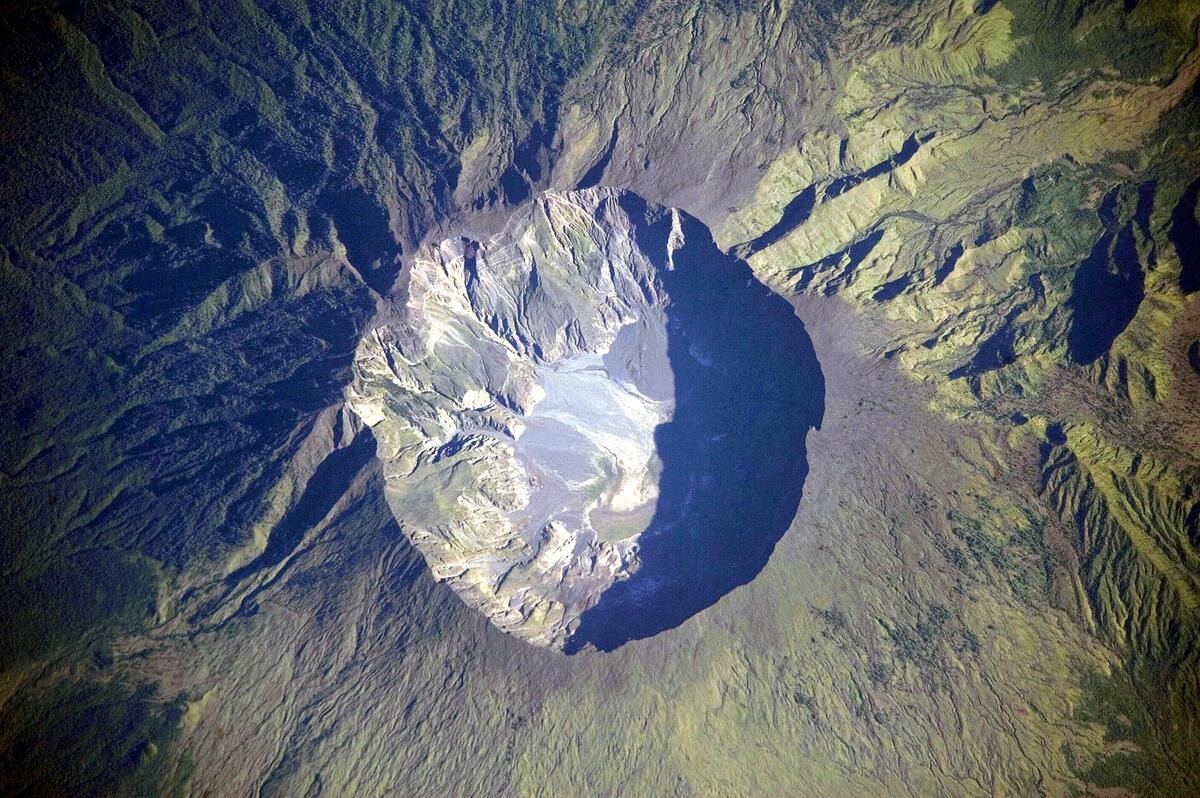
Pyroclastic flows and tsunamis killed on the order of 10,000 people outright; famine and disease on Sumbawa and Lombok killed many more. Total estimates run from about 71,000 to 92,000 — the deadliest eruption on record. Then the sulfur went global. 1816 became the "Year Without a Summer": global temperatures fell by roughly 0.4–0.7 °C, snow fell in New England in June, harvests failed across Europe, and Mary Shelley wrote Frankenstein during the cold, wet summer on Lake Geneva. All that from a VEI 7 — a tenth of a supereruption.
Set off a VEI 7 at Tambora →Krakatoa, 1883: how loud it was, and why it killed 36,000
Krakatoa (Krakatau), in the strait between Java and Sumatra, climaxed on the morning of 27 August 1883: a VEI 6 of about 20 km³ that destroyed most of the island. The explosions were heard on Rodrigues, about 4,800 km away near Mauritius, as the distant roar of guns — often cited as the most distant sound ever reported. Barographs around the world recorded the pressure wave as it circled the planet several times.
The noise did not kill. At least 36,417 people died, the vast majority drowned by tsunamis tens of metres high that destroyed 165 coastal villages (see the deadliest tsunamis).
Anak Krakatau, 2018
A new volcano, Anak Krakatau — "child of Krakatoa" — emerged in the old caldera in 1927. On 22 December 2018, during an eruption, part of its flank slid into the sea. The tsunami struck Java and Sumatra at night without warning and killed 437 people. A steep island volcano does not need a giant eruption to cause a deadly tsunami.
Pinatubo and Hunga Tonga: the modern giants
Mount Pinatubo in the Philippines erupted on 15 June 1991 after 500 years of quiet — the second-largest eruption of the 20th century. It ejected about 5 km³ of magma (roughly 10 km³ of ash and pumice as deposited), its column reached 35 km, and a passing typhoon soaked the ash until thousands of roofs collapsed. About 350 people died; Philippine and USGS scientists had forecast the eruption and evacuated the area, saving at least 5,000 lives.
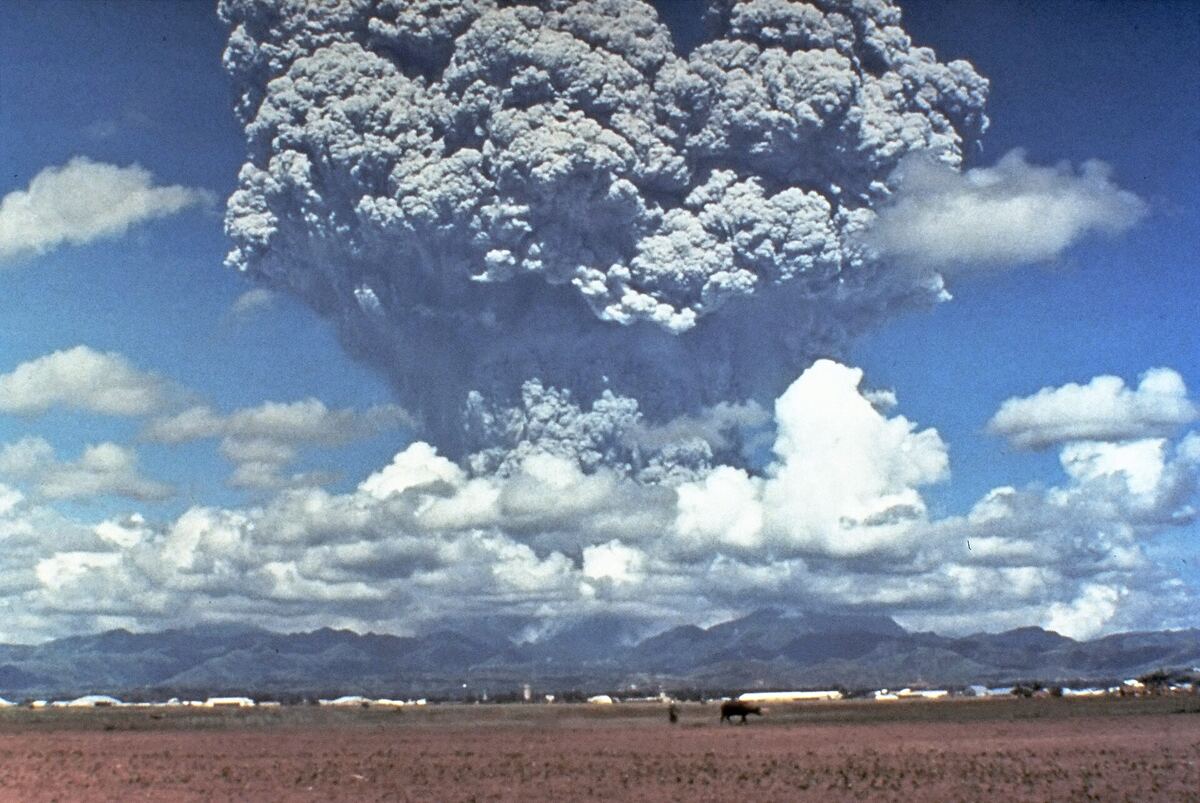
Pinatubo also gave the cleanest measurement of what a VEI 6 does to climate. Some 15–20 million tonnes of sulfur dioxide spread a veil around the globe and cooled average surface temperatures by about 0.5 °C in 1992; the effect faded after 1993.
Simulate Pinatubo at VEI 6 →Hunga Tonga–Hunga Ha'apai, a mostly submerged volcano, exploded on 15 January 2022. Its plume reached about 57 km, into the mesosphere — the highest volcanic plume ever measured. Sources rate it VEI 5 or 6. Its tsunamis crossed the Pacific: a handful of people died in Tonga, and two drowned in Peru. Erupting through the sea, it released little sulfur but about 146 million tonnes of water vapour — roughly 10% of all the water in the stratosphere — so it left no clear cooling signal.
Vesuvius and Pompeii, AD 79
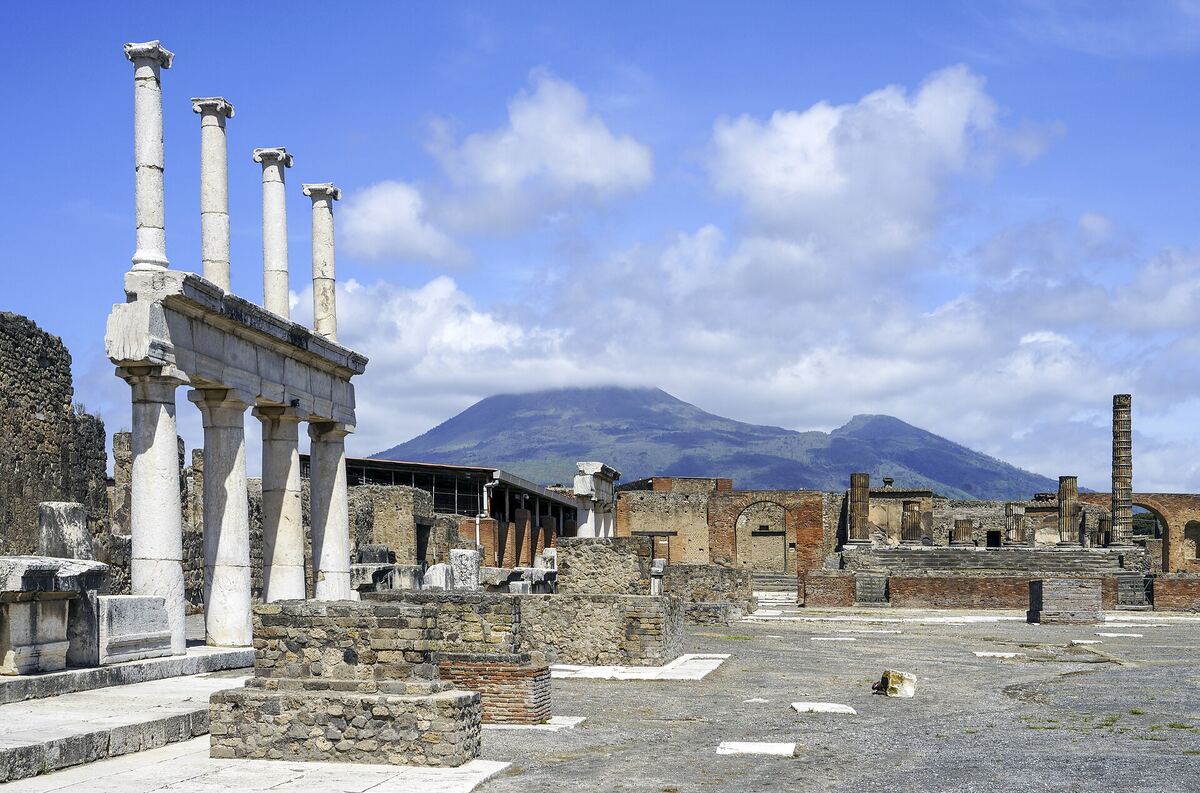
The eruption that buried Pompeii was a VEI 5, roughly 4 km³ of magma. A column more than 30 km high rained pumice on the town, 10 km from the vent, for most of a day until roofs gave way. Then the column collapsed into pyroclastic surges — ground-hugging avalanches of hot gas and ash — that hit Herculaneum in the night and Pompeii the next morning, killing everyone still there within minutes.
The Pompeii eruption date: August or October?
The traditional date, 24 August AD 79, comes from manuscript copies of Pliny the Younger's letters. But excavators kept finding autumn clues, and in 2018 they found a charcoal inscription dated to the equivalent of 17 October; charcoal fades fast, so it was probably written days before the disaster. Many researchers now favour 24 October AD 79, though the debate is not formally closed.
Over a thousand victims have been recovered at Pompeii and about 300 at Herculaneum; the total is unknown. Today about 700,000 people live in Vesuvius's red zone, which Italy's plan aims to evacuate within 72 hours.
See a VEI 5 at Vesuvius →Mount St. Helens, 1980
At 8:32 a.m. on 18 May 1980, a magnitude 5.1 earthquake shook loose the bulging north face of Mount St. Helens — the largest debris avalanche in recorded history, about 2.5 km³. Uncapped, the magma blasted sideways at over 480 km/h, flattening forest across some 600 km². Within 15 minutes the ash column passed 24 km.
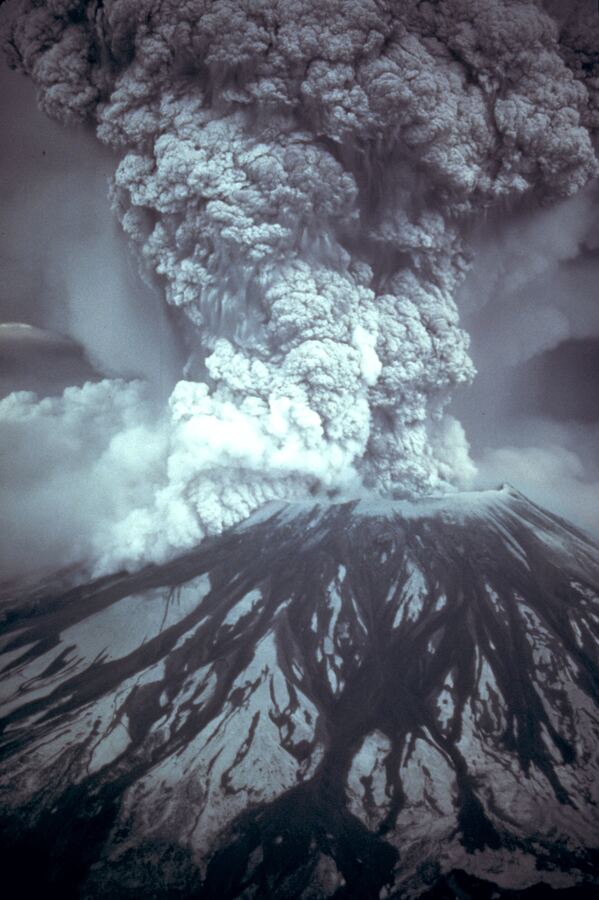
Fifty-seven people died. It was a VEI 5 with roughly 1 km³ of tephra — a thousandth of a supereruption. The mountain's last eruption ran from 2004 to January 2008: a quiet extrusion that built a new lava dome of about 93 million m³ in the crater. It has been quiet since.
Kamchatka: the original lateral blast
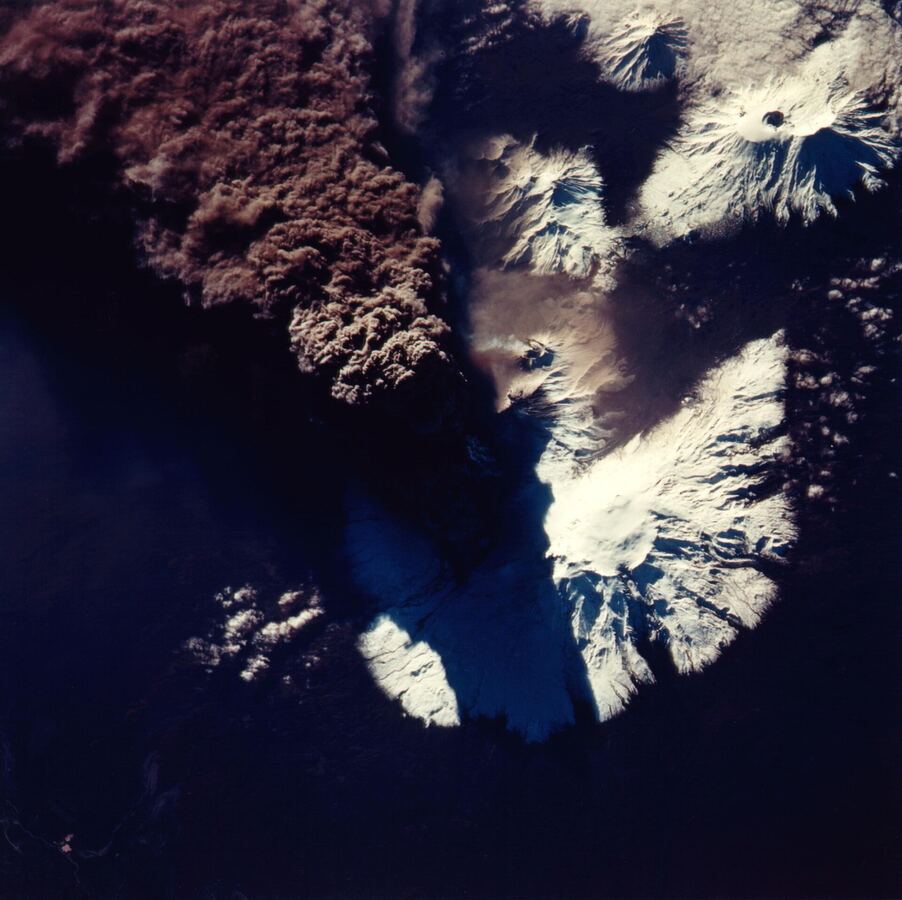
Russia's Kamchatka Peninsula has about 30 active volcanoes. Klyuchevskaya Sopka, about 4,750 m, is the highest active volcano in Eurasia and one of the most active. Its neighbour Bezymianny did on 30 March 1956 what St. Helens did in 1980: a directed blast tore away its summit and flank and devastated about 500 km², and it became the reference case for this type of eruption. In April 2023 nearby Shiveluch collapsed part of its lava dome, sending ash to about 20 km and pyroclastic flows up to 19 km.
The deadliest eruptions: size is not the whole story
Rank eruptions by death toll and the list reshuffles. What kills is usually the tsunami, the mudflow, the pyroclastic flow into a town — or the famine afterwards.
Mont Pelée on Martinique was a VEI 4, yet on 8 May 1902 a pyroclastic flow reached Saint-Pierre in minutes and killed almost all of its roughly 28,000 people. Nevado del Ruiz, a VEI 3, sent mudflows that buried the town of Armero hours later. At Unzen in 1792 a collapsing dome fell into the sea and the tsunami did the killing. A small eruption next to a town is deadlier than a giant one in the wilderness.
Biggest volcano vs biggest eruption
The biggest volcanoes are not the ones with the biggest eruptions. Mauna Loa in Hawaii, the largest active volcano on Earth, holds at least 75,000 km³ — about twenty times everything Toba erupted — yet it was built by gentle VEI 0–1 lava flows. In 2020 researchers showed that Pūhāhonu, a long-extinct volcano in the northwest Hawaiian Islands, is about twice that, roughly 148,000 km³, the largest shield volcano known. Tamu Massif in the Pacific was proclaimed the largest single volcano in 2013, but later magnetic surveys suggest it formed at a mid-ocean ridge rather than from one vent.
Try a VEI 5 and a VEI 8 on the same spot and compare the footprints, or see what visitors have erupted over the last 30 days on the recent simulations page. Other scales: strongest earthquakes, meteor sizes.
FAQ
What was the biggest volcanic eruption in history?
In written history, Mount Tambora in Indonesia in 1815: a VEI 7 of around 150 km³ that caused the "Year Without a Summer". In the geological record, Toba in Sumatra about 74,000 years ago was a VEI 8 of roughly 2,800–3,800 km³.
What is a supervolcano?
A volcano that has produced at least one VEI 8 eruption — more than 1,000 km³ of material in a single event, leaving a huge caldera rather than a cone. Yellowstone, Toba and Taupō are examples; the most recent supereruption was Taupō's, about 25,500 years ago.
Is Yellowstone going to erupt?
The USGS says there is no evidence a catastrophic eruption is imminent and that one is unlikely in the next few centuries; the yearly chance is roughly 1 in 730,000. Its caldera-forming eruptions were 2.08 million, 1.3 million and 631,000 years ago.
How loud was Krakatoa?
The 1883 explosions were heard on Rodrigues island, about 4,800 km away, as distant gunfire. Barographs worldwide recorded the pressure wave circling the Earth several times.
What is the biggest volcano in the world?
Mauna Loa in Hawaii is the largest active volcano, at least 75,000 km³. The largest known shield volcano is Pūhāhonu, an extinct Hawaiian volcano about twice as big.
When did Mount St. Helens last erupt?
From 2004 to January 2008, when it slowly built a new lava dome in its crater. Its explosive eruption on 18 May 1980 was a VEI 5 that killed 57 people.
Sources
- Newhall & Self (1982) — The Volcanic Explosivity Index, JGR
- USGS — Questions about supervolcanoes
- USGS — Summary of Yellowstone eruption history
- USGS — Modeling the ash distribution of a Yellowstone supereruption (2014)
- Lane et al. (2013) — Toba ash in Lake Malawi shows no volcanic winter, PNAS
- Kandlbauer & Sparks (2014) — New estimates of the 1815 Tambora eruption volume
- USGS — Which volcanic eruptions were the deadliest?
- Science Advances (2020) — The 22 December 2018 tsunami from flank collapse of Anak Krakatau
- USGS Fact Sheet 113-97 — The cataclysmic 1991 eruption of Mount Pinatubo
- Proud et al. (2022) — The Hunga Tonga-Hunga Ha'apai eruption reached the mesosphere, Science
- NASA JPL — Tonga eruption blasted unprecedented amount of water into stratosphere
- USGS — Mount St. Helens 1980 cataclysmic eruption
- USGS Professional Paper 1791 — The Novarupta-Katmai eruption of 1912
- Science — Ancient graffiti shifts date of Pompeii's destruction by 2 months
- Dipartimento della Protezione Civile — National plan for Vesuvius
- Smithsonian Global Volcanism Program — Sheveluch (Russia), May 2023 report
- USGS — Where is the largest active volcano in the world?
- Garcia et al. (2020) — Pūhāhonu: Earth's biggest and hottest shield volcano, EPSL
- Bogoyavlenskaya & Girina, IVS FEB RAS — Bezymianny volcano: 50 years of activity (in Russian)